The Carnegie-Irvine Galaxy Survey (CGS)
The CGS is formally defined by BT ≤ 12.9 mag and δ > 0º. It contains a representative, statistically complete sample of 605 galaxies of all morphological types, comprising 17% ellipticals, 18% S0 and S0/a, 64% spirals, and 1% irregulars. Roughly 2/3 of the disk (S0 and spiral) galaxies are barred according to the classifications in the RC3. Most of the galaxies are nearby (median DL = 24.9 Mpc), luminous (median MBT = −20.2 mag), and angularly large (median D25 = 3.3′ ). A detailed list of the galaxies and some of their basic properties is given here.
The Galaxy Sample
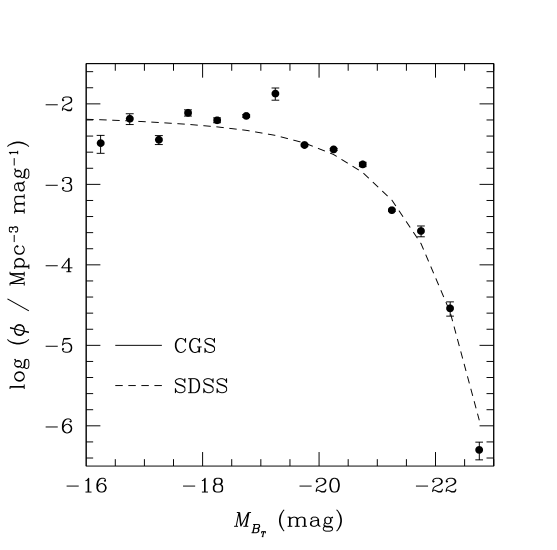
B-band luminosity function. Superposed for comparison is the r-band luminosity function of z ≈ 0.1 galaxies selected from SDSS (Blanton et al. 2003), shifted by B−r = 0.67 mag. The overall agreement indicates that CGS provides an unbiased representation of the nearby galaxy population.
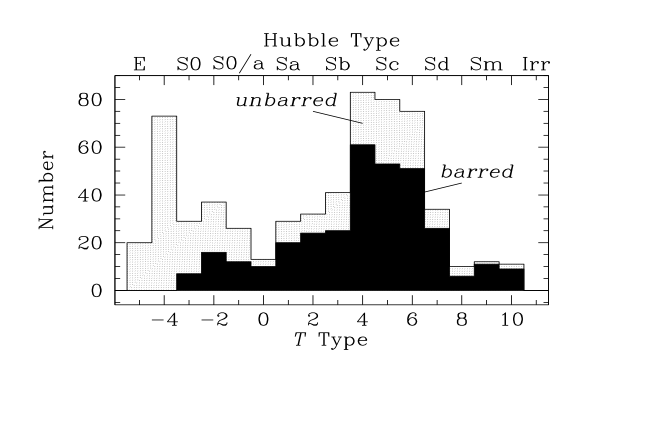
Distribution of morphological types. The bottom axis gives the type index T, and the corresponding Hubble types are shown on the top axis (E: T = −5 to −4; S0: −3 to −1; S0/a: 0; Sa: 1; Sb: 3; Sc: 5; Sd: 7; Sm: 9; Im: 10). Barred (B and AB) and unbarred galaxies are shown in filled and open histograms, respectively.
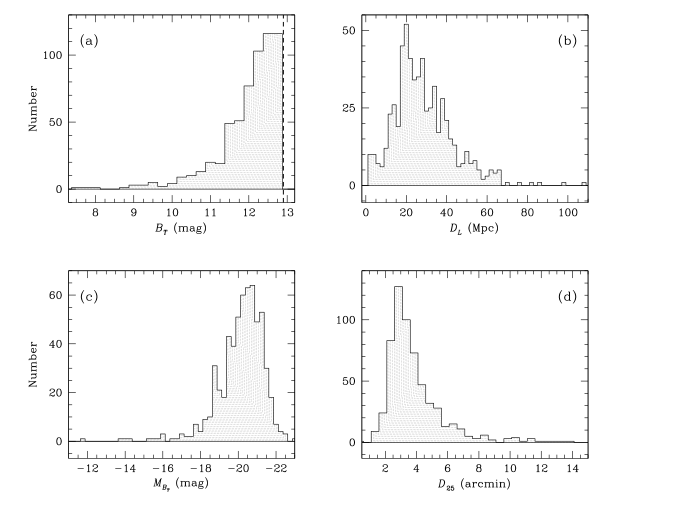
Basic properties. Distribution of (a) total apparent B magnitude, (b) distances, (c) absolute B magnitude, corrected for Galactic extinction, and (d) B-band isophotal diameter at μB = 25 mag arcsec−2.